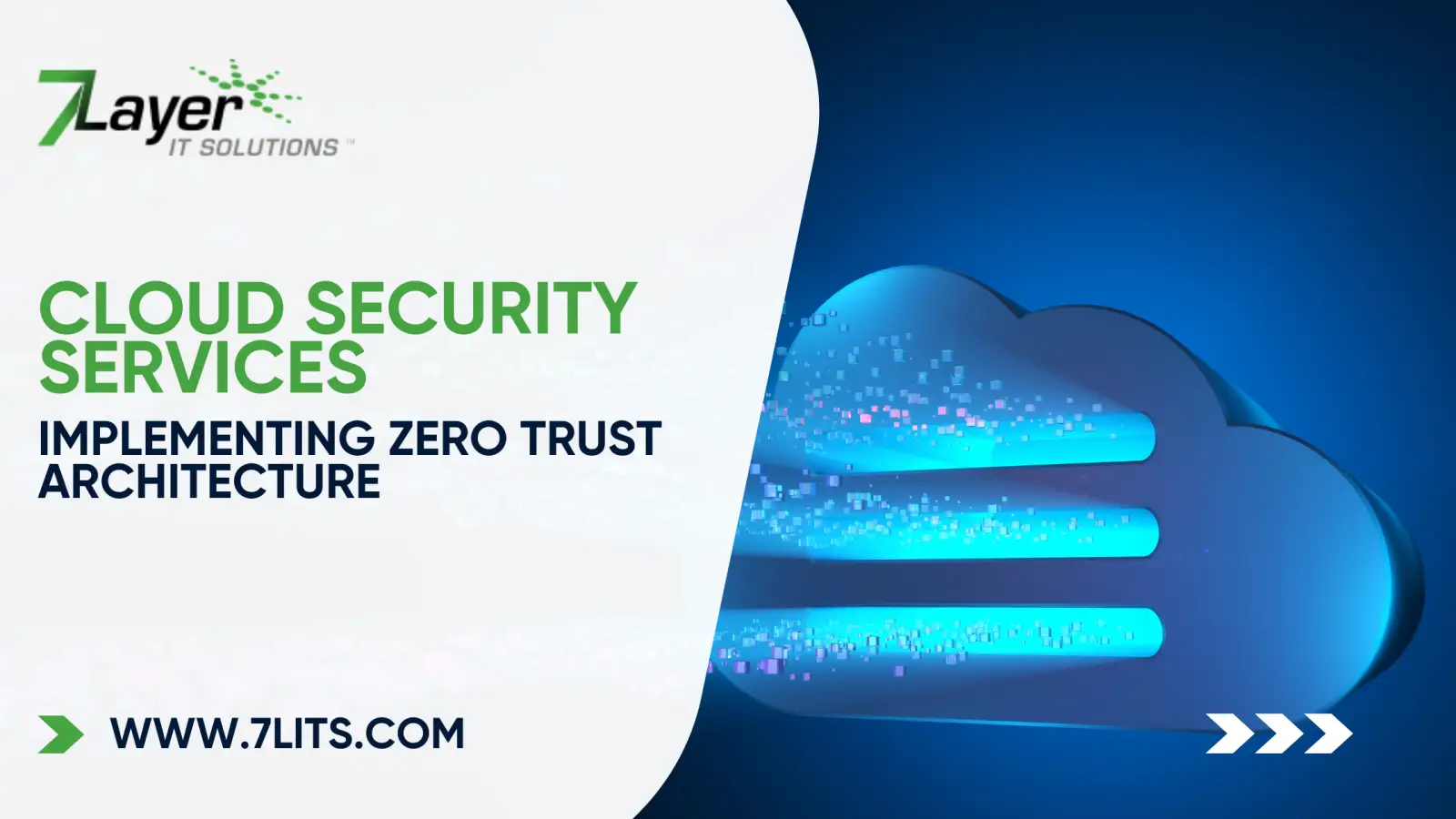
Cloud Security Services protect your business data, applications, and infrastructure across cloud environments, and Zero Trust Architecture has become the standard framework guiding how modern Cloud Security Services are designed and delivered. The old model of trusting anything inside your network perimeter no longer works. Cloud environments have no clear perimeter to begin with.
The shift is now widely accepted. According to a 2026 Cybersecurity Insiders report, 82% of organizations consider Zero Trust essential to their security strategy, yet only 17% have fully implemented it. That gap between recognition and action is where most businesses are still stuck.
At 7 Layer IT Solutions, we help businesses across Los Angeles close that gap through practical Cloud Security Services built around Zero Trust principles. This guide walks through what Cloud Security Services actually cover, what Zero Trust Architecture is, why it matters for cloud environments in 2026, and how to implement it without disrupting your operations.
What Are Cloud Security Services?
Cloud Security Services are the tools, processes, and expert oversight that protect your cloud-based systems, data, and users from unauthorized access, breaches, misconfigurations, and evolving threats. They span everything from identity management to data encryption, network segmentation, and threat monitoring.
The scope of Cloud Security Services has expanded significantly in the last three years. Modern services now cover multi-cloud environments (AWS, Azure, Google Cloud), SaaS applications, hybrid setups, and remote workforces. As cloud adoption has grown, so has the attack surface. Cloud misconfiguration is now one of the most common breach vectors, and businesses relying on default security settings are increasingly targeted.
What Is Zero Trust Architecture?
Zero Trust Architecture is a security model built on one principle: never trust, always verify. Every user, device, and connection is treated as unverified until it proves otherwise, no matter where it originates or who owns it.
Traditional security assumed anything inside your network was trustworthy. Zero Trust throws that out. Whether a request comes from an employee laptop in the office, a phone at a coffee shop, or an internal system, every access attempt gets verified against strict rules.
The framework was formalized by NIST in Special Publication 800-207, which has become the reference standard for Zero Trust design across industries. Most modern Cloud Security Services now build on this framework by default.
Why Zero Trust Matters for Cloud Security in 2026
Cloud environments do not have clear boundaries, and traditional perimeter-based security cannot protect what has no perimeter. That fundamental mismatch is why Zero Trust has moved from optional to essential in 2026.
The threat data makes the case. According to Verizon's Data Breach Investigations Report, 22% of breaches now start with credential theft, making stolen logins the single largest attack vector. Attackers do not need to break in when they can log in. Zero Trust closes that door by verifying every access attempt, even when valid credentials are used.
The financial impact is measurable too. IBM's Cost of a Data Breach Report found that organizations with Zero Trust Architecture in place saved an average of $1.76 million per breach, and detected incidents 61% faster than organizations without it. That kind of reduction is what makes strong cloud risk management something businesses can no longer afford to postpone.
Small and mid-size businesses in particular are feeling the pressure. Research shows SMEs now account for 53.2% of the Zero Trust Architecture market, driven by rising credential-based attacks and the U.S. Small Business Administration reporting that 43% of cyberattacks now target small businesses. For a wider look at how threats have shifted, our Cybersecurity Trends 2026 guide covers the full landscape.
The Core Principles of Zero Trust Architecture
Zero Trust is built on five core principles that shape how modern Cloud Security Services are designed. Understanding these principles is the foundation of any successful implementation.
1. Verify Every Access Request
Every user, device, and connection must be authenticated and authorized before accessing anything, every time. Multi-factor authentication is the baseline, and MFA is now non-negotiable for any Zero Trust setup.
2. Apply Least Privilege Access
Users and applications get access only to the specific resources they need to do their job. Nothing more. This limits how far an attacker can move if they get in.
3. Assume Breach
Design your systems as if attackers are already inside. This changes how you monitor, segment, and respond to threats, shifting from prevention alone to detection and containment.
4. Segment Everything
Break your network into small, isolated zones. If one zone is compromised, attackers cannot move laterally to the rest. This is especially critical in cloud environments where workloads are interconnected.
5. Continuously Monitor and Verify
Zero Trust is not a one-time setup. It requires ongoing monitoring, real-time risk scoring, and automated responses. Continuous verification is what turns Zero Trust from a policy into an active defense system, powering effective cloud data protection at every layer.
How to Implement Zero Trust in Your Cloud Environment
Implementing Zero Trust in the cloud follows a practical six-step process. Skipping any step creates gaps that attackers can exploit.
1. Map Your Assets, Users, and Data Flows
You cannot secure what you cannot see. Start with a full inventory of your cloud resources, applications, and how data moves between them.
2. Strengthen Identity and Access Management
Enforce MFA everywhere, adopt single sign-on, and set up role-based access. Identity is the foundation of Zero Trust, and stronger identity controls immediately reduce risk.
3. Segment Your Cloud Network
Divide your cloud environment into zones. Use microsegmentation to isolate workloads so a compromise in one area does not spread. This is where secure cloud infrastructure design really pays off.
4. Deploy Continuous Monitoring
Real-time visibility into user behavior, device health, and access patterns is essential. This is where Managed Security Operations Center coverage becomes critical.
5. Encrypt Data at Every Stage
Encrypt data at rest, in transit, and during processing. Strong encryption ensures that even if attackers reach the data, they cannot use it. Solid cloud data protection depends on it.
6. Automate Response and Enforcement
Use automated policy enforcement so decisions happen at machine speed. Manual response cannot keep up with modern attack timelines. For businesses without in-house capacity, this is where a strong cloud risk management partner makes the biggest difference.
What Cloud Security Services Include Under a Zero Trust Model
A full stack of Cloud Security Services under a Zero Trust model covers identity, endpoints, network, data, and monitoring, working together as one system.
Here is what a complete Cloud Security Services setup typically includes in 2026:
- Identity and Access Management with MFA, single sign-on, and role-based policies
- Endpoint Detection and Response for continuous device monitoring, covered in depth in our EDR guide
- Network Microsegmentation to isolate workloads and limit lateral movement
- Cloud Data Protection through encryption, tokenization, and data loss prevention
- 24/7 Security Monitoring with a Managed Security Operations Center
- Vulnerability Management including patching, configuration hardening, and continuous scanning
- Compliance Support for HIPAA, PCI, SOC 2, and other frameworks
Each of these layers reinforces the others. When any one is missing, attackers find the gap.
How 7 Layer IT Solutions Delivers Cloud Security Services
If your business is ready to modernize its cloud security posture around Zero Trust, this is where we come in.
7 Layer IT Solutions has been supporting businesses across Los Angeles and the San Fernando Valley since 2007. Our Cloud Security Services are built around Zero Trust principles from the ground up, covering identity management, network segmentation, endpoint protection, continuous monitoring, and end-to-end cloud data protection. For a broader look at how we handle security across your environment, our full Network & Cybersecurity services page covers the wider picture.
Ready to Modernize Your Cloud Security?
Cloud environments demand a security model built for how businesses actually operate today. Zero Trust Architecture is that model, and the businesses moving faster on it are the ones staying ahead of what is coming.
If you want a clear picture of where your cloud security stands and what a Zero Trust rollout could look like for your business, reach out to our team. We will walk through your current setup, identify the gaps, and help you build the kind of cloud risk management framework that actually holds up.